Converter
The converter modules holds the Converter class, which converts XBRL-XML to XBRL-CSV
taking as input taxonomy and instance objects.
Main function is to do an inner join between the XML instance and the preprocessed JSON, to generate an XBRL-CSV file.
- class xbridge.converter.Converter(instance_path: str | Path)
Bases:
objectConverter different types of files into others, using the EBA
taxonomyand XBRL-instance. Each file is extracted and saved in a temporary directory. Then, these files are converted into JSON and again saved in a compressed folder such as ZIP or 7z.Variablesare generated by combining the open keys column with the attributes found within the taxonomymodules. Then, variable’s dimension is extracted from it with the purpose to be used with the context coming from theXML_instance, to create thescenario.Finally, an inner join is done between the variables created and the values from the facts of the
XML_instancecontext.- convert(output_path: str | Path, headers_as_datapoints: bool = False, validate_filing_indicators: bool = True, strict_validation: bool = False) Path
Convert the
XML Instanceto a CSV file or between CSV formats
- convert_csv(output_path: Path) Path
- convert_xml(output_path: Path, headers_as_datapoints: bool = False, validate_filing_indicators: bool = True, strict_validation: bool = True) Path
- class xbridge.converter.FactReconciliation(source_facts: int = 0, converted: int = 0, excluded_non_reported: int = 0, unmatched: int = 0, unrecognized_elements: ~typing.List[str] = <factory>)
Post-conversion accounting of every source fact.
The core invariant is:
source_facts == converted + excluded_non_reported + unmatched
where each detected fact ends up in exactly one bucket.
unmatchedandunrecognized_elementsrepresent facts lost silently — the former detected but matching no table, the latter never recognised as facts at all. A balanced reconciliation with no unrecognised elements means nothing was dropped.- converted: int = 0
- excluded_non_reported: int = 0
- property has_silent_loss: bool
True when facts were dropped without an explicit filing-indicator reason.
Covers detected facts that matched no table (
unmatched) and top-level elements never recognised as facts (unrecognized_elements). Orphaned facts (excluded_non_reported) are not silent — they have their own filing-indicator report — so they do not count here.
- property is_consistent: bool
every detected fact lands in exactly one bucket.
unmatchedis computed as the remainder, so this should always hold; a False result signals a counting bug (e.g. a fact double-counted as both converted and orphaned). It says nothing about whether facts were lost — usehas_silent_lossfor that.- Type:
Defensive accounting check
- source_facts: int = 0
- unmatched: int = 0
- unrecognized_elements: List[str]
Generating variables:
Firstly, variables are generated taking the pre-processed tables that form the modules, which URLs are saved in the index.json file,
and the instance columns that form the XML_instance. If instance have not got any open keys, variables are not going to be generated.
Index.json will look like this:
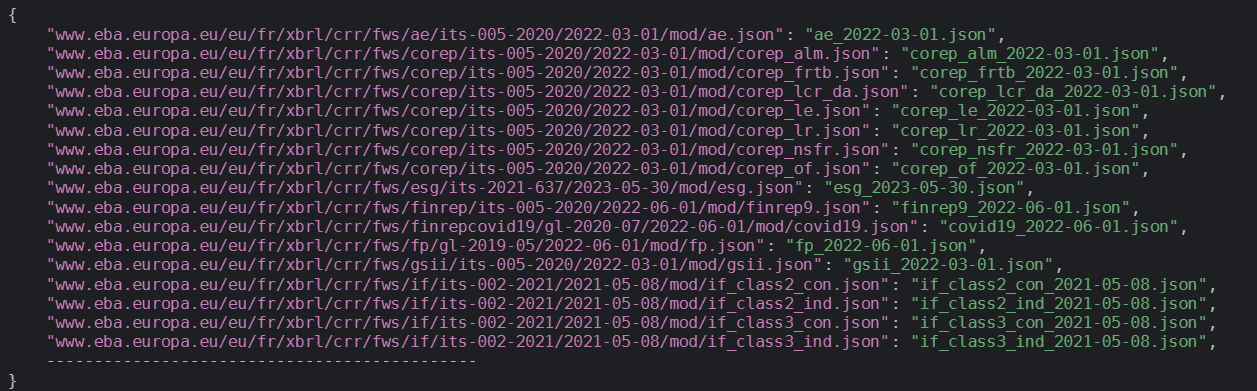
After that, variables are parsed, cleaning them up and an intersection is done with them and the instance columns. Now, the table is generated.
Converting tables:
Tables are generated, filling them with the variables generated before, and save in a CSV file. It will contain the variable version IDs.
This tables have to be treatise, so they can be used in the conversion process. This treatment consists in replacing hyphens with dots, so CSV files can be generated.
Converting filing indicators:
The filing indicators show which tables within the module are reported. Reports.json files only indicate XBRL related metadata and the module URL.
Converting parameters:
Parameters will contain all info related to entity, period, baseCurrency and decimals contained in the XBRL-XML file.
Fact reconciliation:
After a conversion, the converter records a FactReconciliation
on Converter.reconciliation that accounts for every source fact. Each detected fact is
classified as converted, excluded_non_reported (orphaned to non-reported tables) or
unmatched (matched no table definition), and top-level elements never recognised as facts
are collected as unrecognized_elements.
unmatched facts and unrecognized_elements are silent losses — facts absent from the
output without an explicit filing-indicator reason. They are reported through
FactReconciliationWarning / FactReconciliationError under the same strict_validation
flag used for orphaned facts: a warning when False, an error when True. The census reuses
the masks already computed for filing-indicator validation, so it adds negligible overhead.